 Not a Person
Forced to Play: Why Your Vote Can’t Legitimize a System You Never Joined
Listen
Forced to Play
Whether the vote is a real choice — or a thin layer of "chosen" laid over a system you were entered into, which grows on your participation and is building the means to make its control total
This article asks the question underneath everything else: is taking part in the system a choice, or were you entered into it? Every fact here is sourced. The ordinary, official answer is given its full strength before any challenge. Where this is the framework's own reading rather than settled fact, it is labelled — and then the choice is handed to you. There is no need to decide here whether what you're looking at is an accident of structure or something steered on purpose. The point is what it does, how it grows, and where it is going — all of which are visible now.
1. The one claim the whole system leans on
Strip away the detail and the system rests its authority over you on a single idea: you agreed to this, through your vote.
You never personally signed up to any particular tax, rule, charge or penalty. No document ties you to any of it. But you don't need one, the argument goes, because the whole thing answers to you and everyone else at the ballot box. You are represented. That representation is what turns "they said so" into "the law." The demand lands on you as an individual; the permission to make it comes from all of us together; the bridge between the two is the vote.
I've taken that argument seriously throughout, and I take it seriously here. It is the load-bearing beam. Pull it out and the whole structure is standing on nothing but power. So everything depends on whether it's true.
And "true" here has a precise meaning — because agreement has a precise meaning. This article tests it. Not rudely, and with no wish to reach a particular answer, because there's nothing here that needs protecting. There's only something that needs seeing clearly.
2. What real agreement needs — and the question that forces open
The "you consented through the vote" argument is, at bottom, a claim that you agreed. So ask the simplest possible question about agreement: what makes it real?
We all already know the answer, because we use it every day. The one thing agreement cannot do without is this:
Real agreement needs a real option to say no.
A "yes" that could never have been a "no" isn't agreement. It's just compliance.
Here's the everyday version, so it's concrete. Think of two very different "yes"es.
The first: a shop offers you a sandwich for £3. You can walk out, buy nothing, go to the shop next door, or make your own lunch at home. You hand over the £3. That is a real yes — because every path to "no" was wide open and you took the "yes" anyway.
The second: a man steps out of a doorway, holds a knife to your ribs, and says "your wallet or your life." You hand over your wallet. In a trivial sense you "chose" the wallet over the life. But nobody on earth would call that agreement, and the reason is exact: there was no real option to say no. The "choice" was only ever between the mugger's terms. You never agreed to be in the alley with him at all.
Now hold both of those in mind, because the whole article turns on telling them apart. A choice offered when you could genuinely walk away is agreement. A choice offered when you cannot walk away is compliance wearing agreement's clothes.
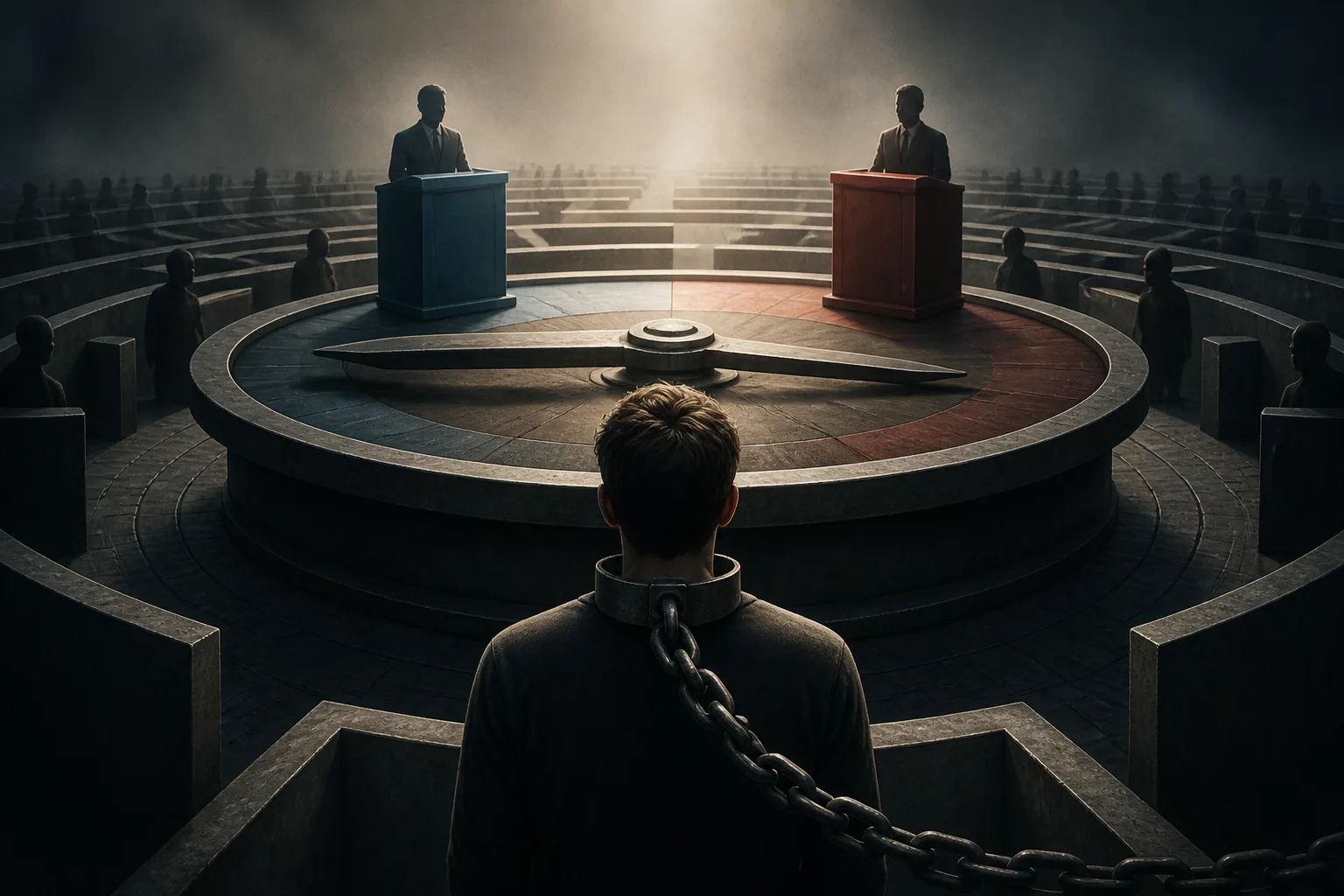
Put it another way, with a picture to carry: imagine someone holds you at a table and says, "pick the red door or the blue door." Your choice of door is real — you genuinely prefer one. But you never agreed to be at the table. And picking a door doesn't magically turn your being held there into something you chose. A choice between options is only ever agreement to the options — never agreement to the situation itself, unless you could have walked away from the situation.
So before we even ask the usual questions — "do elections change much? are the parties really different?" — there's an earlier question that comes first. The usual debate quietly assumes you're the sandwich-buyer, freely picking between options. But are you? Or are you the person at the table, picking a door?
Is taking part in the system itself a choice? Could a living being decline it? Is there a lawful way to simply exist as a free person outside the system's edges — or were you entered into it, and is leaving prohibited?
Because if you were entered rather than joined, the vote is a choice of door offered to someone who was never asked whether they wanted to be in the building. And choosing a door is not agreeing to the building.
Let's answer that first question. Then we'll look at the vote again, and see it for what it is.
3. Were you entered, or did you join? — the foundational breach
Here's a clean test. If taking part in the system is genuinely something you agreed to, there must be a real, lawful way to decline it — to live as a free person outside the system's edges, harming nobody, simply not taking part. If that door exists, taking part is a choice. If that door does not exist — if every living being is brought in and held in by assertion and, in the end, by force — then taking part is not a choice at all. You were entered.
So: does the door exist?
Trace it from the very beginning. A baby is registered at birth — something done about them, before they can want anything, which creates the legal person the system will address for the rest of their life. They're given a number. As they grow, they're treated as stepping into role after role — the taxpayer, the resident, the driver — each one treated as attaching whether or not it was ever knowingly accepted. At no point is any living being ever actually asked: do you want to take part in this system at all? The question is never put — because the system doesn't treat it as open. Taking part isn't offered. It's assumed, asserted, and — when tested — enforced.
Compare that with something you really did join. Think of a gym. You walked in of your own accord. Someone showed you the terms. You signed, knowing what you were agreeing to. You can cancel. You can leave and never come back, and no one will send a bailiff. That is membership you joined — offered, understood, accepted, and exitable.
Now hold the system up against that gym, point by point. Were you shown the terms before you were in? No — you were in before you could read. Did you sign, knowing what you agreed to? No — things were done about you. Can you cancel? No. Can you leave and exist outside, harming no one? No — there is nowhere to stand. Every single feature that made the gym a real membership is absent. What's left isn't membership you joined. It's membership you were entered into.
And try genuinely to find the outside. Point to the lawful space where a free person could just be — beyond the edge, harming no one, taking nothing, simply declining to be a participant. There isn't one. The system's reach is total within its territory: to be present is to be treated as inside, to be inside is to be subject, and there is no recognised standing from which a living being can say "I decline to be a member" and have that respected. The edge has an inside. It has no lawful outside where a living person can stand and not be reached.
In plain words: you did not join this system. You were entered into it, before you could speak, by things done about you. And you cannot leave. There is no door marked "opt out," no lawful ground where a free person can stand outside it and not be reached. Taking part was never put to you as a choice. It was imposed as a condition of simply existing within the territory — and behind that imposition, at the end of every chain, stands force.
This is the foundational breach. Let me make it concrete, because it should be felt, not just read:
A living being is born equal — free, carrying inherent rights, owing no one their obedience. Before that being can understand anything or choose anything, they are entered into a system in which a group of people will hold the power to make rules over them, control what they may do, take a share of what they earn, and punish them if they refuse. The being was never asked. They cannot decline. They cannot leave. That — a free, equal person entered into a lifelong relationship of control and extraction they never chose and cannot exit — is the first breach, and the deepest. Every tax, every rule, every penalty that comes later sits on top of it.
None of this is hidden. It's the plain, open fact of how the system relates to every living being it can reach: you are in it because it says you are, and leaving is prohibited. Hold that fact steady. Everything now turns on it.
4. What the thing actually is — an insatiable, self-propelling entity
Here is the part that makes the foundational breach worse, not better.
When you vote, what do you actually get to change? The visible layer — the ministers, the governing party, the faces on the news, the speeches. But that layer sits on top of something vastly larger that you never voted for and cannot vote out: the permanent machinery of the state. The civil service. The agencies. The regulators. The enforcement bodies. The enormous, ever-growing body of rules created not by elected Acts debated in the open, but through quiet channels that bypass the vote almost entirely.
That machinery doesn't stand for election. It doesn't resign when a government falls. It carries on, continuously, across every change of party — and it is where most of the actual engine of control and extraction lives.
Now, what drives it? Here I have to be honest and careful, because it would be easy to overclaim in either direction. The truth is: the driving force is genuinely open.
- It could be purely emergent — a machine that grows in one direction simply because every incentive inside it rewards growth and punishes shrinkage.
- Or it could be, in part, deliberately directed — and there are signals that don't sit comfortably inside the purely-innocent reading: the coordinated, cross-border push for the same control infrastructures at once, the consistency of the direction regardless of who's elected, the building of surveillance and identity systems whose main use is control of populations rather than service to them.
- Or — most likely — it is both: an emergent engine whose growth is also, at points, consciously steered by those who benefit from it.
I am not going to pretend to resolve that, because it cannot honestly be resolved from the outside, and it does not matter for the point that follows. Whether the thing is an accident that steers itself or a machine that is steered, its behaviour is identical and provable — and its behaviour is what reaches your life.
Let me show you that behaviour with a concrete, everyday example, because "self-propelling" is the kind of phrase that slides past if it isn't made real.
Watch a single rule breed. Suppose a rule is made that, to protect people, anyone selling food from a van must hold a licence. Reasonable enough. But now notice what that one rule sets in motion. A licence needs a body to issue it — so an office is created, with staff, a budget, and a manager. The office exists to administer licences, so its purpose is served by more licensing, not less — it will never recommend abolishing itself. To justify its budget it inspects, and inspection reveals edge cases ("what about market stalls? festivals? home bakers selling online?"), so the rule is extended to cover them. Extension needs more staff. More staff need more budget. More budget needs more activity to justify it, which means more rules, more inspections, more categories brought in. Non-compliance is found, so penalties are created; penalties bring in revenue; revenue funds expansion. And the one van-licence has become a food-standards directorate with hundreds of staff, a thick rulebook, an enforcement arm, and a built-in reason to keep growing — none of which any voter ever asked for, and none of which will ever vote to shrink itself.
Nobody needed to conspire for that to happen. Nobody needed to be evil. Every single person in the story did something locally reasonable. And yet the thing grew in one direction, fed itself, and acquired a permanent appetite — because that is simply what the structure does when left running. That is "self-propelling." And whether or not a hand was also on the wheel steering it faster, the wheel turns that way on its own.
Now multiply that one van-licence by every area of life, across decades, and you have the entity. So let me name its behaviour plainly, because the behaviour is the point:
It is insatiable. Its appetite for control does not level off; it grows. Its need for funds — to build its infrastructures, to action its decisions, to pay for the things it chooses whether or not the people agree — does not level off; it grows. It is self-propelling: it expands in crises and never shrinks back, settling always at a higher baseline. It has a strong, visible direction of travel — more rules, more reach, more extraction, more surveillance, more enforcement. It stands over the majority, asserting ever more control and ever more extraction, and it is consolidating its ability to track the population and enforce its assertions on them. And it is accelerating.
Call it the deep state if that's the term you reach for — but understand that the label is not the point and the cabal question is not the point. The point is the entity's behaviour: a self-growing, self-feeding thing with a direction of travel, standing over a population it was never granted real agreement from, reaching further into their lives every year. Whether a hand is on the wheel or the wheel turns itself, it is heading the same way — and it is heading there faster.
5. How far it now reaches — the appetite changing the fabric of life
This is not abstract. The entity's appetite is now changing the basic fabric of human life, and the specifics are on the record.
It is taking more of your life itself. One plain way to measure extraction is to ask how many days of the year a person works purely to meet the state's total take before they keep a single penny for themselves. In the UK that point now falls in June — meaning, in effect, you work from January until around the start of summer for the system, and only then begin working for yourself and your family.
Make that concrete by shrinking it to a week. Imagine the state took its whole share not across the year but across your working week — Monday to Friday. On today's numbers, you would work Monday, Tuesday, and most of Wednesday for the system, and only from Wednesday afternoon onward would you be working for yourself. Now notice the direction: that line has moved later in the year across the decades, not earlier (earlier articles traced the tax burden to the highest sustained level on record, and still climbing). So the honest way to say it is this — the share of your working life the system takes before you keep anything is large, and it is growing. Its appetite is quite literally eating further into the days of your life, and the trajectory points toward the day it claims not three days of your week but four.
And it is reaching into parts of life that used to be beyond it:
- Speech. The Online Safety Act gives a state regulator sweeping power over what may be said in the public square online, backed by vast fines and criminal liability. A state body now sits in judgement over public speech, and that reach has one documented direction: wider.
- Children and how they are raised. Legislation now moving through Parliament creates compulsory registers of home-educated children and, for the first time, removes the automatic right to home-educate a child subject to a child-protection enquiry — the state able to require a child be returned to state education against the family's wishes. And the model of compulsory state schooling descends, as documented history, from the Prussian system, built deliberately to produce an orderly, obedient, uniform population. The direction is toward less room to raise and teach a child outside the state's frame.
- Identity and the right to work. A mandatory digital ID, announced for the end of this Parliament, intended to be required for the right to work — opposed by a petition that drew millions of signatures almost at once. A single credential required to earn a living is the keystone of a system that can track, condition, and ultimately switch off a person's ability to take part in ordinary life. It turns the "no lawful outside" of Part 3 from a legal fact into a technical one.
- The body, and what goes into it. The framework's characterisation — offered as such — is that the entity increasingly treats the bodies of free people as within its remit: normalising pharmaceuticals and chemical additives in the food supply as if they were simply essential and beyond question, and eroding the plain principle that a person with bodily autonomy decides what enters their own body. Whatever view you take of any particular measure, the direction — toward the body as a site the system may reach — is the thing to notice.
- Property and ownership. The same characterisation applies to ownership: a steady drift from a model where you own things outright toward one where you access them on terms, by permission, revocably. Picture the difference plainly. Owning a book means it is yours — no one can switch it off, revoke it, or read over your shoulder. "Accessing" a book on a device you don't control means it can be altered, withdrawn, or monitored, and your use of it is permitted rather than owned. Now imagine that shift spreading from books to your money, your car, your home, your very ability to transact — permission increasingly baked into the infrastructure itself, so that it is required before you can act, rather than a freedom you hold until someone lawfully stops you. That is the direction.
- And the wellbeing of the people themselves — a population living inside an accelerating machine of control and extraction, its mental health and sense of agency pressed by a life that feels less and less like something it chose and more and more like something it is processed through.
Join it up. An insatiable, self-propelling entity, which you were entered into and cannot leave, is right now building the technical infrastructure — digital identity, consolidated records, pervasive surveillance, permission built into the plumbing of daily life — to make its reach total and exit impossible. That is where the trajectory points if it continues and consolidates: not a dramatic seizure, but the quiet completion of a system in which there is no longer even the possibility of standing outside — where "no lawful outside" becomes "no actual outside," enforced automatically, at the level of whether you can work, bank, move, speak, or decide what enters your own body.
6. Why most people can't see it — belief, and the boiling frog
If the direction of travel is this visible, why do most people not see it? This is the framework's reading, offered plainly as a reading — but it's worth saying, because it explains the strange calm around a thing that should alarm.
The belief was installed. From the first years of school through a lifetime of media, the situation is normalised: that the system is simply how things are, that it is inevitable, that participation is natural and good and not even a question, that your status as its subject is a plain fact rather than an assertion. People don't so much consent to the system as get conditioned to be unable to see it as a thing that could be otherwise. The education and media infrastructures — themselves part of the entity — install the belief that there is nothing to see. It is a little like growing up in a house where one room was always locked: you don't resent the locked room, you don't wonder about it, you simply never think of it as a room you might enter, because "that door doesn't open" was true for as long as you can remember.
And the change is slow enough to stay invisible. The old image of the boiling frog fits exactly: a frog dropped into hot water leaps straight out; a frog in water heated one degree at a time never notices the danger until it's too late to move. Each new rule, each new charge, each new piece of surveillance is small on its own, and reasonable-sounding, and arrives among a thousand distractions — many of them produced by the system itself. No single degree is alarming. Nobody feels the water get hotter. So the population does not notice the temperature rising; it walks, unalarmed and largely unaware, toward an endpoint its installed beliefs mask from view: a life lived entirely inside the system, disconnected from nature and from life as a free choice — the system's version of life, mistaken for life itself.
That is the quiet tragedy of it. Not that people chose this — but that most have been conditioned not to notice they were entered into it, and distracted from seeing where it goes.
7. What the vote actually touches — and why it barely moves the entity
The foundational breach stands on its own: a membership you were entered into and can't leave isn't something a vote inside it can make legitimate. But the vote reaches even less than most people assume — and the evidence is mainstream. Let me take the three findings in turn, and give each one a concrete picture, because these are the most abstract points in the article and the easiest to skim past.
The budget is inherited, not chosen. The leading finding in the study of how governments budget is called incrementalism: the single best predictor of this year's budget is last year's budget, plus a small nudge. Here's what that means in a picture. Imagine a new government sweeps in on a landslide, promising transformation. It sits down to write its first budget — and discovers that the pensions are already committed, the debt interest is already owed, the health service, the schools, the defence contracts, the hundreds of thousands of public salaries are all already running and cannot simply be switched off. By the time the fixed, inherited commitments are accounted for, the genuinely new money the government can move in any direction of its choosing is a thin sliver at the very edge — a few pennies in each pound. The landslide changed the driver. It barely touched the budget, because the budget was overwhelmingly already written before the driver arrived.
The entity grows one way only. Its size and reach behave like a ratchet — the mechanism in a socket wrench that turns freely one way and locks solid the other. Picture exactly that tool. You can tighten and tighten; it will not loosen. The state behaves the same way with a crisis: a war, a crash, an emergency arrives, and the state expands sharply to meet it — new powers, new spending, new agencies. Then the crisis passes. And the powers do not go back. The spending settles at a new, higher baseline. The agencies, now staffed and funded, find new reasons to exist. The 1799 income tax is the perfect specimen: introduced as a temporary measure to fund a war, promised to end when the war ended — and still here, more than two centuries later, permanent and vast. The ratchet clicked forward and locked. And — this is the part the vote can't fix — it ratchets forward under every party alike. They argue about how fast to tighten. None of them loosens it.
The parties converge on the fundamentals. Imagine two shops on the same street competing for the same crowd of shoppers standing in the middle. To win, each shop edges toward the middle where the crowd is — and the closer they both get, the more alike their windows look. That is what competing for the same swing voters does to the main parties: it pulls them both toward the centre, toward broadly the same positions on the things that decide elections. So you are offered a genuine choice of shop — a real choice about who runs things and in what style — but on the deep questions of direction, the two windows increasingly show the same goods. You get a real choice about who drives and how fast. You rarely get a choice about where the road goes.
And most of the machine was never on the ballot at all — the permanent apparatus of Part 4, unelected, continuous, much of it grown through channels that bypass open debate (the van-licence directorate that no one ever voted into existence and no one can vote out).
In plain words: your vote reaches the driver, the speed, and the trim. It does not reach the budget (inherited whole), the direction (a one-way ratchet under every party), the deep settlement (both shop-windows converging), or the permanent machine (unelected, off the ballot). Inside the membership you were entered into, the thing you choose is a thin margin on top of an entity moving under its own power.
8. So what is the vote, really?
Put it together, with nothing hidden:
- The system's reach is defended as legitimate because you agreed through the vote.
- Agreement needs a real option to say no — and you could never decline to take part. You were entered before you could choose; there's no lawful outside; leaving is prohibited. (The foundational breach, Part 3.)
- So the vote is a choice inside a membership you never agreed to and can't resign. It can agree to the options (driver, trim). It cannot agree to the membership — you can't, from inside and after the fact, agree to what was forced on you before you could choose. (The mugging victim really did "pick" the wallet; it was still not agreement to the mugging.)
- The deepest conversion of your status — from free, equal living being into lifelong subject of control and extraction — did not happen through any Act or any vote. It happened at the point your participation was imposed and made impossible to leave: upstream of every ballot. The vote cannot reach back and bless it.
- And the entity that presses hardest on you runs largely beyond the vote anyway (Parts 4 and 7).
So the vote is a thin layer of "chosen" painted over a system you were entered into. Real in its small compartment — you do pick the driver. But laid over a membership you never agreed to, an entity you can't vote out, and a direction no election has reversed. It makes something imposed look chosen. That is its function, whether or not anyone designed it so.
9. The choice this leaves with you — handed over, not argued shut
Here the article does what the others mostly didn't. It will not close the question for you. It lays the structure bare and hands you the decision — because this is a decision each person must make for themselves.
The ordinary, official answer is real, and I'll state it at full strength, because you can't choose without it:
- Maybe being entered into a system you didn't choose is just the nature of living among others. You're born into a family, a language, a country — none picked — and a legal order is no different. To live in society is to be subject to it. On this view there is no "outside" because a free person with no obligations to the order around them is a fantasy, and the vote is the fairest agreement any society has managed.
- Maybe the continuity across elections is agreement, not its absence — people broadly keep choosing the settlement they have.
- Maybe the power to peacefully remove rulers is the agreement that counts — real, precious, paid for in blood by peoples who lacked it. A people who can throw out their government without a shot fired hold something most of human history never had.
- Maybe each measure in Part 5 is defensible on its own terms — safety online, protection of children, convenience in identity — and the alarming picture only appears when you line them up, which is a trick of framing, not a fact about the world.
These are serious answers. The evidence here does not knock them down. Anyone who takes this piece as proof that "the whole thing is illegitimate and you owe it nothing" has overreached as badly as the system does the other way — and this work has never trafficked in either overreach.
And here is the framework's reading, labelled as a reading, not proven fact:
- That agreement to the options is not agreement to the situation; that a membership you could never decline was never agreed to, however familiar; that being born into a family is not remotely the same as being entered, under threat of enforcement, into a lifelong relationship of control and extraction with an insatiable entity that grows regardless of your vote; that the vote is a thin "chosen" over a breach it cannot reach; and that when you can see the direction of travel, and see the infrastructure of permanence being fitted now, the question of how to choose otherwise is not paranoia — it is the most practical question a free person can ask, and its window is closing by the system's own design.
Both are set before you. I won't pretend the first is obviously true and the second a fringe doubt — because whether assertion-backed-by-force is truly law is a live question even among the most senior judges. Nor will I pretend the second is settled, because a court would apply the first. It is genuinely open. And it is genuinely yours.
10. The two things this platform sees
If your answer is that you want to understand this and choose with open eyes, be clear about the two distinct things this work is for — because they are different, and both matter.
One: how to maximise freedom and minimise control and extraction within the system. This is the practical, lawful work — becoming familiar with the truth of law itself, and seeing that the law, absent uncontrolled assertion, genuinely does contain avenues and protections. The point is not that the law is your enemy. The point is that the system reaches you largely through assertion dressed as law, and that assertion can be made visible and challenged. A simple way to picture it: imagine someone hands you an invoice for a debt you don't recognise. You are not refusing to pay lawful debts — you are simply asking the one fair question: show me the agreement I signed. If they can, you pay. If they can't, the invoice was only ever an assertion. Knowing the two kinds of person, the presumed roles, the missing agreement, how to govern your interface through lawful structures, how to put your position on the record — this is how a living being stands, deliberately and lawfully, in a different relationship to the entity than the one presumed onto them, and holds more of their own freedom and their own substance while doing so.
Two: seeing the system as it actually is, viewed from outside it — because outside is where you truly sit as a living being. This is the harder and more important seeing. From inside, conditioned by a lifetime of installed belief, the system looks like reality itself — inevitable, total, simply how things are. It is like a fish, for whom the water is not "the water" but simply everything there is — invisible precisely because it is everywhere. Step outside, even in the mind, and the water resolves into what it is: not reality, not nature, not life, but an entity — a thing with edges, a thing that was built, a thing that grows more powerful through the unconscious participation of a conditioned majority; that imposes more control and builds more infrastructure to surveil and enforce; that protects itself from awareness and from free speech; that reaches for property and finance; that is working to make permission inherent in the infrastructure rather than something needed before it can lawfully stop you. Seeing that clearly is not despair. It is the one thing that was always required before anything else becomes possible.
11. Fed, or starved — the real tipping point
Here is the thing the installed belief most completely hides, and it is the hinge of everything.
The entity is fuelled by participation. It grows on the energy, the compliance, the funds, the unquestioned belief of the majority. It is not a fact of nature. It is not inevitable. It is a choice — a choice currently made, overwhelmingly, unconsciously, by people who were entered into it, conditioned to see it as reality, and distracted from seeing where it goes.
Let me show you why that matters with the plainest possible example, because this is the point most people have never been allowed to see.
Consider how a single official actually controls a crowd. One police officer can hold back a street of a thousand people — but not by force. One officer cannot physically overpower a thousand. The thousand stay behind the line because each of them believes they must, and each of them complies. The officer's power is real in its effect, but it rests entirely on the compliance of the many. The moment the crowd stops believing the line must hold — the moment they simply, collectively, decline to comply — the line is gone, and no amount of asserting can restore it. The authority was never, at bottom, in the officer. It was on loan from the crowd, and the crowd never noticed it had lent it.
That is the entire structure of the system, scaled up. A minority can assert control over a vast majority only for as long as the majority fuels the assertion — by believing in it and complying with it, mostly unconsciously. The control is on loan. And what keeps you in is therefore power and enforcement — not legitimacy, and not reality. Reality says you are a living being with inherent rights, born equal, owing no one your obedience. The system — paid for by your own participation — says you are its subject, to be controlled, extracted from, and penalised by its own assertions, and it tells you that you chose those assertions. The question this whole article hands you is simply: did you?
And if the entity is fuelled and grows by your participation, then there is a tipping point most people have never been told exists: the point at which the thing stops is not the point at which it is defeated by force — it is the point at which it is starved rather than fed. It stops the way the police line "stops" when the crowd withdraws its compliance: not by being beaten, but by being un-fed. The moment enough living beings see the entity for what it is and lawfully withdraw their unconscious participation, the assertion stands exposed for what it always was — a minority controlling a majority on borrowed authority — and the thing that looked inevitable is revealed as a choice that can be unmade.
So the choice is yours, and I'll hand it over exactly as it stands, with no thumb on the scale:
If your choice and your trust is to stay within the system, then do so — but do so knowingly, with your eyes open to what it is and where it is going, rather than unconsciously, because the belief was installed. That is a legitimate choice, and a free being may make it.
And if your choice is to exist as the free living being you are, and to lawfully withdraw your participation from an entity heading somewhere you would never have chosen — then notice that the window to do so is closing, by the system's own design. The infrastructure of permanence — the digital identity, the consolidated records, the surveillance, the permission built into the plumbing — is being built now. The time to separate from a cage is before the last door is fitted.
12. The honest limit — and the honest force
One last thing, held in two halves that must never be separated.
This platform is where separation begins — not the whole answer, and never a shield against force. Seeing the entity clearly, familiarising yourself with the truth of law, making assertion visible and challengeable, governing your interface lawfully, ceasing to volunteer your participation where you lawfully can — that is the real beginning of standing in a different relationship to the system. It is the first move of a free being who has seen the cage and decided to stop painting "chosen" on its bars.
But the entity is real, it is powerful, and it is building reach. No understanding and no document makes a bailiff, a court, or a consolidated digital system vanish. Withdrawal is a direction you begin to travel, lawfully and with clear eyes — stating your position on the record, governing your interface, refusing to volunteer the presumptions — while the force remains real and must never be ignored. You do not miss a deadline, skip a hearing, or treat an officer as if he weren't there because you have "seen the system." Think of it this way: a man who has realised he is in a cage is wiser than the man who hasn't — but he is still, for now, in the cage, and running at the bars breaks only the runner. Clear sight of the entity sits underneath; honesty about its force sits on top. Both, always, together.
A free being who sees the cage clearly is still, for now, within reach of it — and the thing that keeps them there is force, not legitimacy or reality. But seeing it clearly, and in time, is the one thing that was always required before freedom from it becomes possible at all.
13. In one breath
- The system is defended as legitimate because you agreed through the vote — and agreement needs a real option to say no. (The freely-bought sandwich is agreement; the wallet handed to the mugger is not.)
- You had no such option. You were entered into the system before you could want anything, given a number, treated as stepping into role after role, with no lawful outside and leaving prohibited — nothing like a gym you joined and can quit. That is the foundational breach: a being born equal and free, entered into a lifelong relationship of control, extraction and punishment it never chose and cannot exit.
- What drives the thing is genuinely open — emergent, deliberately steered, or both; there are signals pointing beyond pure accident, and it would be dishonest to close that door. But it doesn't matter, because the behaviour is the same either way and it's provable (watch one van-licence breed a whole directorate): an insatiable, self-propelling, accelerating entity that grows in one direction and consolidates the means to track and enforce.
- Its appetite is changing the fabric of life: months of every year worked for the state before yourself (three days of your week, heading for four); control of speech, of raising children, of identity and the right to work (mandatory digital ID, opposed by millions); and, as the framework's characterisation, reaching toward the body and toward ownership (access-by-permission replacing owning, permission built into the infrastructure).
- Most people can't see it because the belief was installed (the locked room you never think to open) and the change is slow (boiling frogs, distracted by the system's own noise), walking unaware toward the system's version of life mistaken for life itself.
- The vote barely moves it anyway — budgets inherited whole (the landslide government that finds the budget already written), a one-way ratchet under every party (the socket wrench that won't loosen), parties converged (two shops edging to the same middle), the real machine off the ballot. So the vote is a thin layer of "chosen" over a membership you were entered into.
- The ordinary answers are real and set before you at full strength: maybe entered-membership is just what society is; maybe continuity is agreement; maybe removing rulers is the agreement that counts; maybe each measure is fine and only the line-up looks alarming. The data doesn't knock them down.
- The framework's reading, labelled: agreement to options is not agreement to the situation; a membership you could never decline was never agreed to; and seeing the trajectory, choosing otherwise in time is the most practical question there is — its window closing by the system's own design.
- This platform sees two things: how to maximise freedom within (the law, absent uncontrolled assertion, has real avenues — show me the agreement I signed), and how to see the system from outside — where you truly sit as a living being — as the entity it is (the water the fish never notices), not the reality it pretends to be.
- The hinge: the entity is fuelled by participation and held in place by power and enforcement — not legitimacy, not reality (the one officer holding a thousand only while the thousand comply). It stops not when it is defeated but when it is starved rather than fed. Stay if you choose — but knowingly. Or exist as the free being you are and lawfully withdraw — but notice the window is closing.
- Separation begins here — it is not the whole answer, and never a shield against force. A man who sees the cage is wiser than one who doesn't, but is still in it; running at the bars breaks only the runner. See the entity; see its force; act with clear eyes.
You were entered into this without being asked, and leaving is prohibited. Inside it, you may choose the driver of an insatiable entity heading, under its own power, toward total control — while the means to make it permanent are fitted now. Whether that vote is your consent, or only its appearance, was never answered for you. What keeps you in is force, not legitimacy — and the thing grows only because it is fed. Now you can see it well enough, and perhaps still in time enough, to decide whether you go on feeding it, or lawfully withdraw.
Comments
Sign in to join the conversationLoading…