 Not a Person
How Taxes, AI and Quiet Rules Are Forcing You Into Complete Dependence on the System
Listen
The Quiet Convergence: How Independence Is Being Priced, Taxed and Regulated Out of Reach
A different way to read the news
Most of us read the news one story at a time. Here's a tax change. There's a new rule about wood burners. Over here, a report about AI taking jobs. Somewhere else, a story about raw milk, or home schooling, or the price of heating your home. Each story arrives in its own box, with its own stated reason, and we file it away and move on.
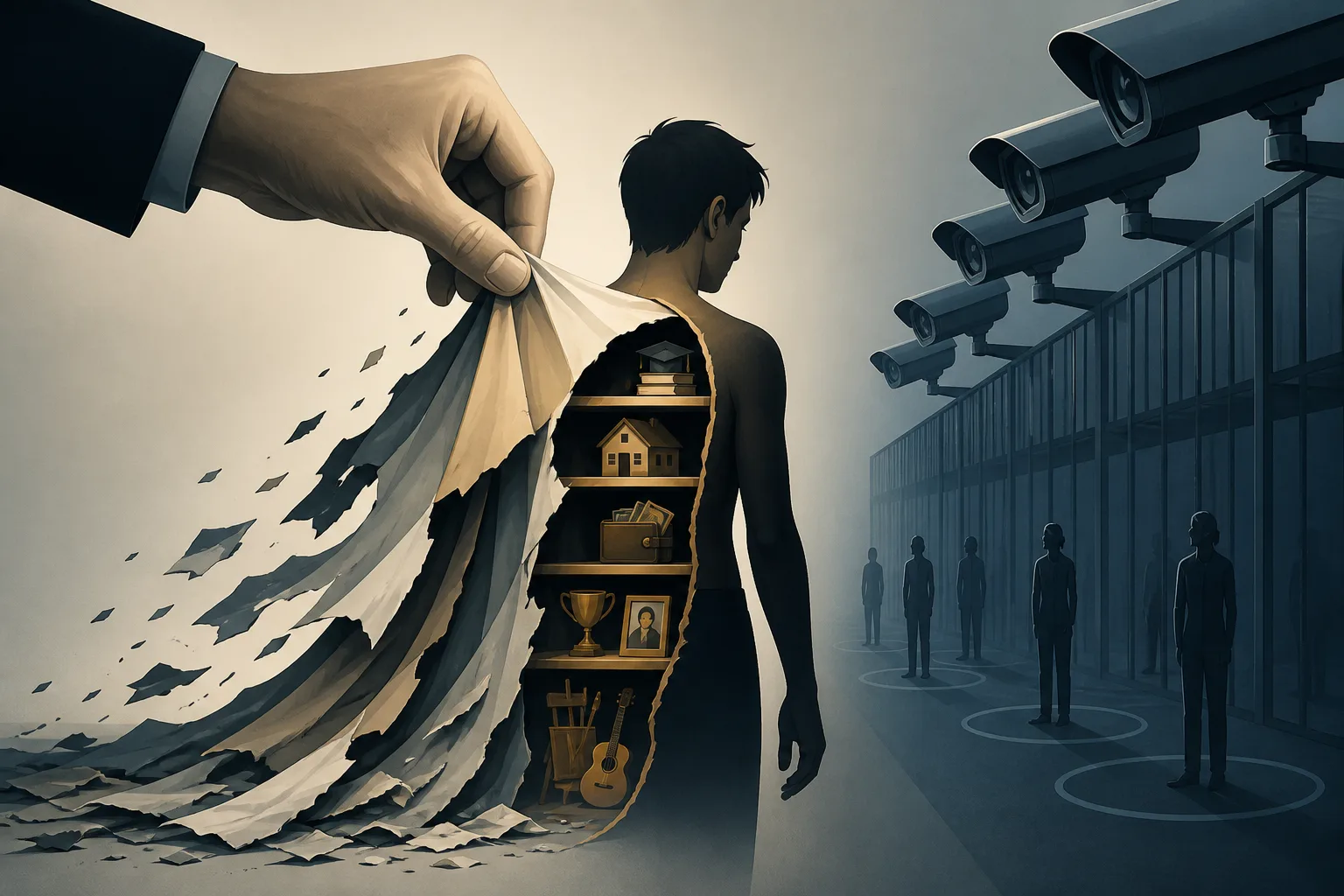
This article asks you to do something different. Instead of reading each story for its stated reason, read all of them together for their shared effect.
Because when you line them up — the taxes, the rising costs, the vanishing jobs, the rules about food and fuel and how you raise your children — a pattern appears that no single story shows you on its own. The pattern is this: the things that let an ordinary person stand on their own two feet are, one by one, being made more expensive, more regulated, more difficult, or simply taken off the table.
You don't have to believe anyone planned this for the pattern to matter. You only have to look at where it leads. So let's look — plainly, with real examples, and with the actual facts underneath each one.
We'll follow two strands. The first is about what you have being drained away, and your ability to earn it back shrinking at the same time. The second is about the tools of self-sufficiency — growing food, keeping animals, heating your home, raising your children your own way — being fenced off one by one. Then we'll look at where the two strands meet.
Strand One: The Draining
Taxes you never voted for, by a method you were never shown
Imagine your landlord promised never to raise your rent. "The rate stays exactly the same," he says. And it's true — the number on the contract never changes. But every year, your wages go up a little to keep pace with rising prices, and every year he quietly moves the line of what counts as "the expensive flat," so that more and more of your money falls on the wrong side of it. Your rent "rate" never rose. But you're paying far more. And technically, he kept his promise.
This is almost exactly what has happened to income tax in Britain — and it has a name. It's called fiscal drag, and it is the quietest tax rise there is.
Here's how it works in plain terms. The government sets a line — called the personal allowance — below which you pay no income tax at all. That line has been fixed at £12,570 since April 2021. If it had risen with inflation, it would be about £15,000 now. It didn't rise. So you now pay tax on money that should have been tax-free.
The same trick works at the top. Fiscal drag is the Treasury's quietest tax rise. Average earnings have risen roughly 25% since the freeze began in 2021, while the 40% threshold sits at £50,270 — exactly where it was in 2021/22. As your pay creeps up with inflation, you drift across a line that hasn't moved, and suddenly you're a "higher-rate taxpayer" — not because you're richer in real terms, but because the line stayed still while the water rose.
And this isn't a short-term measure. The Personal Allowance and the higher-rate threshold have been frozen since 2021/22 — the OBR now models the freeze running until April 2031. That's a decade of the line standing still while everything else moves.
The scale of what this quietly extracts is enormous. The revenue raised in 2025/26 was an estimated £28.4 billion. And it pulls millions of ordinary people into tax bands that were once reserved for the well-off: the OBR warns 8.3 million people will pay more tax by 2029-30 due to frozen thresholds, as fiscal drag quietly raises the UK's tax burden to its highest level since WWII.
Step back and look at the whole picture. The UK's tax burden will rise to a record high of 38% in 2030-31. That's the highest share of the nation's income taken in tax since before most people reading this were born.
Here's the thing to notice, in the spirit of reading effects rather than reasons. Nobody stood up and announced a tax rise on working people. In fact, the opposite was promised. Despite Labour's manifesto pledge not to raise the main rates of income tax, National Insurance or VAT, the government is leaning heavily on "stealth" measures such as threshold freezes. The rate never rose. The promise was "kept." And yet more is being taken from you than at almost any time in living memory. The method was chosen precisely because it doesn't look like what it is.
Inflation: the second, invisible tax
There's a second drain running alongside the first, and it's even less visible because it never appears on a payslip or a tax form at all.
When more money is printed and pushed into the economy, each pound in your pocket buys a little less. Prices rise. This is inflation, and it works exactly like a tax — it quietly transfers the value out of your savings and your wages — except no one ever voted for it and no one ever sends you the bill. Your bank balance looks the same. It simply buys less bread, less fuel, less of everything.
Put the two drains together and you can feel why things seem tight even when, on paper, you're "earning more." Your wages rise a little. Inflation eats part of that rise. Fiscal drag taxes more of what's left. The number in your bank account goes up; the life it buys goes down. That gap — between the headline number and the lived reality — is where an enormous amount of quiet extraction happens, and it's why so many people feel they're running faster to stand still. They are.
And much of what makes life expensive now lands on the essentials — heating, food, fuel — the very things you can't opt out of. A tax on luxuries you can avoid. A rising cost of warmth and food, you cannot. Which brings us to the second half of the first strand: the drain is deepening at the exact moment your ability to earn your way out of it is being pulled away.
The Layering: How Inflation Multiplies Your Taxes, and Why Everything Now Has a Fee Attached
We've seen two drains so far: the stealth tax of frozen thresholds, and the invisible tax of inflation. But to understand why money feels so tight — why a pay rise never seems to reach your pocket — you have to see how these drains don't just sit side by side. They multiply each other. And the mechanism that does the multiplying is hiding inside almost everything you buy.
Let's start with two things you probably bought this week: a tank of fuel and a pint.
A pint, and the tax you pay on the tax
Picture a pint in a pub. Not long ago it was three or four pounds. Today the average pint of lager in a pub is £4.70 — and in London a pint has hit £8. That rise alone is a drain. But look at what's actually inside the price, because there are two completely separate taxes stacked on top of each other — and the second is charged on the first.
Here's how it works, in the plainest terms.
First there's duty — a tax on the alcohol itself, based on how strong it is. On a standard pint, that's roughly 54–59p handed over before anything else. Then, on top of the whole lot, there's VAT at 20%. And this is the crucial bit, confirmed by the accountants who deal with it: VAT is added on top of the retail price, which already includes alcohol duty.
Read that again slowly. The VAT isn't charged on the beer. It's charged on the beer plus the duty. You pay a tax (VAT) on top of another tax (duty). A tax on a tax. On that average pub pint, around a third of everything you hand over is tax — roughly £1.37 of a £4.10 pint goes to the taxman through VAT, alcohol duty, business rates and the rest, while the pub's own profit is a thin 7.5%.
And the exact same trick sits in your fuel tank — only there it's even starker, because fuel is taxed so heavily, the price has just gone haywire, and fuel does something a pint can't: it then pushes up the price of almost everything else.
A tank of fuel, and the tax that rides every war
When you fill up you pay fuel duty — a flat 52.95p on every single litre, the same whether fuel is cheap or expensive — and then VAT at 20% is charged on top of both the fuel and the duty. As the RAC Foundation states plainly: fuel duty is levied at a flat rate of 52.95p per litre, while VAT at 20% is then charged on both the product price and the duty. You are paying tax on a tax, on every litre, every time. That VAT-on-the-duty alone adds over 10p to every litre — a tax charged purely on another tax, forever.
And across a full tank, the tax share is enormous. Tax makes up just over 50% of the price of both petrol and diesel — and when the underlying fuel is cheap, the tax share climbs even higher, toward 65–75%. Half of what you hand over at the pump isn't fuel at all. It's tax, some of it tax charged on other tax.
Now watch the price itself move — because this is where your instinct that fuel has gone wild is exactly right, and where something very revealing shows up.
Diesel sat around £1.40–£1.43 a litre through much of 2025. Then conflict struck again, and the price didn't creep — it climbed hard. The UK average diesel price has surged back toward the £2 mark, with reported averages around 197.6p–199.9p per litre and some motorway stations charging as much as £2.16. And the named cause is a war: according to the RAC, filling the average diesel car now costs over £109 — around £30 more than before the US-Iran conflict that has sent pump prices spiralling.
This is the second time in a few years the same thing has happened. The all-time record — 191.4p for petrol and 199.1p for diesel — was set in July 2022, right after Russia's invasion of Ukraine. Prices then fell back for most of 2025, and are now surging again on the back of fresh conflict. Twice in three years, a government-driven war has whipped the price of the most essential fuel back toward £2.
But here is the detail that gives the game away. Back in 2022, when diesel first hit £2, a barrel of crude oil cost well over $120. Today, with pump prices surging back toward those same record levels, the barrel is nowhere near that — crude is trading around $65–68. The raw ingredient is far cheaper than it was at the last price peak, yet drivers are being charged almost the same at the pump. The price you pay has not followed the price of oil back down. Once a crisis pushes the pump price up, it is remarkably reluctant to come back down even when the underlying cost does — a pattern so well known it has a nickname: "rockets and feathers," prices that shoot up like a rocket and drift down like a feather, if they drift down at all. The crisis gets used. The barrel falls; your pump price doesn't.
And here's the part that matters most. When that pump price rockets, the VAT rockets with it — automatically, with no announcement, because VAT is 20% of the price. Fuel duty is a fixed amount, so it doesn't move with the market. But VAT is a percentage, so the moment the pump price jumps from £1.43 to £1.99, the VAT the government collects on each litre jumps too — all by itself, no minister required.
So follow the sequence, because it's remarkable once you see it. A government helps set off a war → the war spikes the fuel price → the pump price stays high even as the barrel price falls back → and the same government then automatically collects more tax on that inflated price, because its VAT is a percentage of a bigger number. The crisis and the windfall travel together. The household in the middle pays twice over: once in the raw cost, and again in the extra tax riding on top — for events it had no hand in, and gets no benefit from.
But we're not finished, because diesel doesn't stop at the pump.
The hidden multiplier: diesel moves everything, so everything rises
Here is the huge effect that's easy to miss, and it may be the most important part of this whole section.
Almost nothing you buy was made where you bought it. The food in your supermarket, the clothes on the rail, the parts in your boiler, the materials that built your house — nearly all of it travelled to you, and nearly all of it travelled by diesel. Lorries run on diesel. Vans run on diesel. Ships and trains and tractors run on diesel. As one logistics analysis puts it bluntly: diesel is the backbone of road freight, and fuel is one of the largest operating costs in transport, so when diesel prices rise, those increased costs are typically passed down through the supply chain to the end consumer.
So think about what a diesel spike actually does. It doesn't just make your tank more expensive. It makes it more expensive to move every single thing — which means the farmer's costs rise, the food processor's costs rise, the delivery company's costs rise, the supermarket's costs rise. Each one passes the increase along, and by the time a loaf of bread or a bag of apples reaches the shelf, it carries the fuel rise inside its price. Industry bodies have been explicit about this: hauliers have warned that record diesel costs feed directly into the price of food and nearly all goods on shop shelves. Fuel is the first domino. Food and almost everything else is the row that falls behind it.
Now bring the VAT back in, because this is where it compounds into something genuinely large.
When the price of those goods rises because diesel pushed up the cost of moving them, the VAT on those goods rises too — because, once again, VAT is a percentage of the price. So a single diesel spike, set off by a distant war, does all of this at once:
- It raises the tax on the fuel directly (more VAT at the pump).
- It raises the cost of transporting virtually every physical good.
- Which raises the shelf price of virtually every physical good.
- Which raises the VAT collected on virtually every physical good.
One event, started by a government's decision elsewhere in the world, ripples outward into the price of nearly everything you own and eat — and the government collects more tax at every stage of that ripple. That is not one tax rise. It is a tax rise that reproduces itself across the whole economy, quietly, automatically, off the back of a single crisis.
And the same fuel heats your home
The ripple doesn't even stop at goods. The same energy shock that lifts diesel lifts the cost of heating, because oil, gas and the fuels that warm homes rise together in these crises. Around 1.5 million UK households still heat their homes with heating oil — essentially a close cousin of diesel — and they feel the spike directly in the tank in the garden. For everyone else, the same wholesale energy turmoil that moves fuel moves the gas and electricity price too. So the crisis that makes it dearer to drive, and dearer to buy food, also makes it dearer to stay warm — three of the most unavoidable costs of being alive, all lifted at once by the same event, with VAT riding up on each.
Now watch what inflation does to all of it
Step back, and you can see why these drains don't just add up — they multiply.
VAT is a percentage. Percentages grow all by themselves when prices rise. That's true of fuel, of food, of your restaurant meal, your new boiler, your phone, your clothes, your car repair — anything carrying VAT. Whenever inflation pushes those prices up — and remember, inflation is itself strongly shaped by the choice to print money, and now by these fuel-driven ripples — the 20% VAT on all of it quietly rises in lockstep. Inflation isn't just eating your money. It's simultaneously handing the government an automatic pay rise on every percentage-based tax you pay.
So the squeeze isn't one thing. It's a stack, every layer pulling the same way at once:
- Your wages rise a little to keep up with inflation.
- Fiscal drag taxes more of those wages, because the thresholds are frozen.
- The money that survives buys less, because inflation raised prices.
- Those higher prices carry more VAT, because VAT is a percentage of a bigger number.
- On fuel and alcohol, part of that VAT is tax charged on duty — a tax on a tax.
- And a single fuel spike raises the price and the VAT of nearly every transported good and your heating besides — the whole ripple multiplying outward from one distant event.
Six layers, no single one of them dramatic on its own, every one pointing the same way. Stacked together, they explain almost perfectly why the number in your bank account can go up while the life it buys goes down.
The duties climb too — "in line with inflation"
You might think at least the duty part holds still. But even that creeps up — and it creeps up using inflation itself as the justification. Alcohol duty is the clear example: it is raised each year in line with RPI inflation, so the official wording is that it "stays the same in real terms." That phrase sounds fair, even modest. But notice what it means: as inflation rises, the duty is deliberately lifted to match it. So inflation lifts the duty directly, and inflation lifts the VAT on top of it, and the VAT is partly charged on the duty itself. Every lever moves the same way, and "keeping pace with inflation" is the phrase that makes each move sound reasonable. Alcohol duty alone was an estimated £12.5 billion in 2024/25, forecast to rise to £14.1 billion by 2030/31 — billions more, through a mechanism most drinkers never see.
And then: a fee for everything
So far we've talked about taxes — the big, named ones. But there's a whole second world of extraction that doesn't even call itself tax. It calls itself a fee, a charge, a penalty, a permit. And it has exploded.
Take parking and fines — the clearest case, because the numbers are now extraordinary. In the most recent year, parking charges brought in a record £1.4 billion of annual profit for councils in England — and note that word profit, this is surplus left over after the service is paid for. It leapt in a single year, rising by more than a fifth in 2025 from the previous year, when it stood at just under £1.2 billion. One council alone — Westminster — made £109 million from parking.
The fines machine behind it has grown just as fast. In 2025, private parking firms issued around 14.5 million charges to motorists, a 24% jump in a year; add the roughly 11.8 million penalty notices issued by councils, and the total exceeds 26 million fines a year, with combined revenue put at £1.76 billion. And it's being deliberately scaled up to collect more: one north London council alone doubled its wardens, pushing its parking income up 25% to £11.5 million in a single year.
Read that for effect. An entire industry built on charging ordinary people for leaving a car somewhere — growing over 20% a year, generating record "profit," with its own expanding army of enforcers. It is extraction, dressed as administration.
And parking is just the most visible case. The same pattern is everywhere: a charge for something that used to be free, or a fee for a thing that used to simply be allowed. A fee to apply for a document, and another to replace it. A charge to drive into a zone, or drop off at an airport. A permit to park outside your own house. A licence for this, a registration for that. There's even a hidden tax buried inside your insurance — Insurance Premium Tax, now 12% on your car, home and pet cover — which most people have never heard of, because it's simply baked into the quoted price.
Each one, on its own, is small. "It's only a few pounds." That sentence is the most expensive one in modern life, because it's the one that lets each new charge slip past unchallenged. And there are now hundreds of them.
The thing to notice: more and more, for less and less
Here's the observation that ties the whole section together, and it's the one that stings.
All this extra extraction — the taxes on taxes, the automatic VAT rises, the duties climbing "in line with inflation," the fuel ripple multiplying the price and the tax of nearly everything, the forest of new fees and record fines — is growing at precisely the moment when ordinary people feel they get less and less for it in return. Potholes stay unfilled while parking "profit" hits records. Services are cut while the overall tax burden climbs toward a record 38% of national income by 2030-31 — the highest since the Second World War.
And a great deal of what's taken flows toward things with no direct benefit to the household paying it — above all the distant wars that set off the whole fuel ripple in the first place, spiking the price of driving, eating and heating all at once, and handing the government more VAT at every step of the chain. You pay more. You see less of it come back to your own street. The gap between what leaves your pocket and what returns to your life has rarely been wider.
So add this to the rest of Strand One. It isn't just that a few taxes are high. It's that there are many taxes and fees, layered on top of one another, with some charged on top of others, all of them multiplied automatically by an inflation that is itself a kind of tax — and the whole thing whipped upward by crises that governments themselves set in motion, crises that then ripple through the price of nearly everything you buy while the barrel of oil that supposedly caused it sits quietly cheaper than before.
This is what "being drained" looks like up close. Not one big hand in your pocket. A hundred small ones, each politely insisting it's only a few pounds — while the percentages quietly do the heavy lifting in the background, multiplying outward from a single distant event, growing on their own, every single time a price goes up.
And every price, as we've just seen — from the pint, to the pump, to the loaf of bread that travelled to the shelf behind a diesel engine — keeps going up.
The ladder is being pulled up: AI and the vanishing first job
For as long as anyone can remember, there has been a basic deal: if things get expensive, you work more, you earn more, you climb. The first rung of that ladder is the entry-level job — the junior role where a young person learns, proves themselves, and starts to climb.
That first rung is being sawn off.
The clearest place to see it is in technology, where the tools doing the replacing are built. Entry-level software developer jobs have declined nearly 20% since 2022, with other AI-exposed entry-level roles like customer service and accounting down 13%, according to a Stanford University study. These aren't obscure jobs. They are the classic starting points for a generation.
In Britain specifically, the collapse is stark. UK tech companies cut graduate roles by 46% from 2023 to 2024 and expect another 53% drop by 2026. And it's spreading beyond tech: UK-wide data indicate that all graduate hiring fell 8% in the 2024/25 academic year — the first year-on-year decline since 2020. This contraction was led by technology and pharmaceuticals, the sectors hiring the most graduates.
Why is this happening? Because the work that used to be given to a new starter — the routine, learnable tasks — is exactly what the new tools do cheaply. Entry-level developer roles are disappearing fastest because they primarily involve code generation, documentation, and bug fixing, tasks AI now handles faster and cheaper. Employers are open about choosing the machine over the newcomer: as many as 37% of managers said they'd rather use AI than hire a Gen Z employee.
And this is described by the people building the technology not as a blip but as the beginning. Anthropic CEO Dario Amodei warns that within one to five years, AI could eliminate half of all entry-level white-collar jobs and push unemployment up to 10%–20%. Whether or not that exact figure proves right, the direction is not in dispute by the people closest to it.
Now here's the part that connects to everything else — and it's your own observation, turned into a plain picture.
These tools don't just do one job. A capable AI "agent" can increasingly organise and carry out whole chains of tasks that a team of people used to do — not just the writing, but the planning, the chasing, the admin, the follow-up. As that capability grows, it doesn't stop at one industry. It moves through them.
And there's a strange loop hidden inside it. All these systems — the apps, the platforms, the services being built with AI — ultimately need customers. Customers need money. Money, for most people, comes from jobs. If the same tools that build the platforms are busy removing the jobs that give people money to be customers, then the system is, in a real sense, eating its own tail: automating away the very audience it needs to survive. You don't have to predict the exact ending to see that this is not a stable arrangement, and that ordinary people are caught in the middle of it — told to "retrain" for a ladder whose lower rungs keep being removed.
Strand one, in one breath
So the first strand is this. More is being taken — through a stealth tax most people can't even name, and through inflation that never appears on any bill. And at the very same moment, the ability to earn it back is shrinking — the first jobs are vanishing, the ladder's bottom rungs are going, and the tools doing it are accelerating. Drained from one side; cut off from the other.
A person under that kind of pressure starts looking for another way to stand on their own feet. For thousands of years, that other way has been the same: grow some of your own food, keep a few animals, heat your own home, raise your own children, lean on your own community. Step partly outside the money economy so that when money gets tight, you're not entirely at its mercy.
Which is exactly where the second strand begins.
Strand Two: The Fencing-Off of Self-Sufficiency
Here's the pattern to watch for in this strand. In almost every case, nothing is banned outright. Instead, the independent option is made harder, costlier, registered, inspected, licensed, or wrapped in a fine — until for most ordinary people it quietly stops being worth it. A right you technically still have, but practically can't use, has been removed just as surely as one struck from the books. It just doesn't make a headline.
Let's walk through the essentials of standing on your own feet, one by one.
Heat: the war on the log burner
Start with keeping warm without depending entirely on the grid. For millions, that means a wood burner — cheap heat, often from wood you can gather or buy locally, independent of the gas and electricity companies.
Watch how it's being fenced off. Not banned — fenced.
First, what you're allowed to burn. The sale of wet wood and traditional house coal has been banned in England since 2021. Then, which stove you're allowed to buy: only Ecodesign-compliant stoves can now be sold. Then the fines, in large parts of the country: councils can issue penalties for excess smoke in Smoke Control Areas — and those zones cover most of England's towns and cities. The screw keeps turning: ministers have floated cutting the permitted smoke-emission limit by around 80%, from five grams an hour down to one. And this winter the enforcement is live: households in dozens of towns and cities are being warned they face fines of up to £300 under the Clean Air Act if their chimney emits too much smoke.
So far, so familiar — restrict the fuel, prescribe the stove, fine the use. But there's a second squeeze that's less visible and arguably more powerful, and it operates not on the stove but on the person allowed to fit it.
The installer squeeze — regulating the fitter out of the job
Here's something most people don't realise until they try to get a stove put in. You are not, in practice, free to simply buy a wood burner and have any competent local tradesman install it. The installation is now a regulated act, and the number of people lawfully able to sign it off has been deliberately narrowed.
Fitting a wood burner is "notifiable" building work — it has to be certified as meeting Building Regulations. There are only two routes. Either a registered competent-person installer (in practice, someone registered with a scheme such as HETAS) fits it and self-certifies the work, or you must apply to your local-authority Building Control and pay a fee to have it inspected and signed off. In other words, the law funnels you toward a narrow pool of scheme-registered installers — and if you fall outside that pool, you pay the council instead.
That registration isn't a quick form. To join and stay on these schemes, installers must hold the recognised qualification, register with the scheme, pay ongoing membership and assessment fees, and submit to audits and inspections. Each certificate lodged carries its own notification fee. None of this is free, and all of it is passed on. The ordinary, capable local builder who could physically do the job perfectly well is, for practical and legal purposes, shut out of certifying it — because the cost and paperwork of getting and keeping the registration isn't worth it for the occasional stove.
The predictable result is fewer approved installers chasing rising demand — and the price has gone exactly where you'd expect. Industry guidance now puts the cost of installing a wood burner at anywhere from around £1,500 to £5,000 or more once the stove, the lining of the chimney, the hearth and the certified labour are added up — with the fitting itself a large and rising share of it. The hardware might be a few hundred pounds. The regulated installation is what turns an affordable independent heat source into a major outlay.
The same squeeze, everywhere heat and water are involved
And this is the part to really notice, because the wood-burner story is just one instance of a much bigger pattern: the tradesman himself has been progressively regulated, licensed, and fenced into a narrow registered pool — across heating, plumbing and especially gas — and every narrowing of who's allowed to do the work pushes the price of having it done further up.
Gas is the starkest case. It is simply illegal for anyone not on the Gas Safe Register to carry out gas work. The register is a legal monopoly: a plumber, however skilled, cannot lawfully touch a gas boiler, a gas fire or a gas cooker unless they hold the specific qualifications, pay to join Gas Safe, and keep paying to renew — with registration running to hundreds of pounds a year before a single job is done, plus the cost of requalifying every few years. The effect is a deliberately restricted supply of people allowed to do essential work that millions of homes depend on. Fewer permitted hands, rising demand, and — inevitably — rising prices and longer waits.
The broader plumbing and heating trade has been pulled the same way through a thicket of "competent person" schemes, mandatory registrations, and certification requirements for more and more categories of work. Each scheme sounds sensible on its own — safety, standards, accountability. But stand back and look at the combined effect: the number of people lawfully permitted to carry out ordinary heating and plumbing work has been steadily reduced, the cost of being one of those permitted people has steadily risen, and both of those feed directly into what you pay. This is basic supply and demand doing exactly what it always does — when you shrink the number of people allowed to supply something people badly need, the price goes up. Licensing restricts who may do the work; a smaller supply of workers meets the same demand; and the price of the service climbs accordingly.
Read it for effect, as always. No one has banned you from heating your home. But the cheap fuel is restricted, the cheap stove is illegal to sell, using it risks a fine across most of the country — and the pool of people lawfully allowed to install it, or to touch your boiler, has been squeezed down to a registered few whose rising costs land in your bill. For a family already drained by everything in Strand One, the self-reliant way to stay warm has quietly become a licensed, certified, inspected and expensive undertaking. The stated reason, each time, is safety. The effect, added together, is that warming your own home on your own terms slips further out of reach — and that the independent tradesman who once made it affordable has been regulated toward the margins right alongside the independent homeowner.
Food from an animal: the raw milk example
Now food — specifically, the most direct food relationship there is: buying milk straight from the farmer who milks the cow. No supermarket, no processing giant, no middle-man. You and the farm.
It's still legal. But look at the fence around it. The sale of raw cow's drinking milk is legal in England, Wales and Northern Ireland but it can only be sold directly to the consumer by registered farms at the farm gate, farmers at registered farmers' markets, or distributors using a vehicle as a shop. It's illegal to sell raw cow's drinking milk in any other setting. In Scotland, the simpler answer: sales of raw drinking milk and raw cream are completely banned.
The farmer must be registered, inspected, labelled, and policed. Producers must be registered, are inspected roughly twice a year through combined hygiene audits, must meet defined microbiological standards, and must carry a statutory health warning. And crucially, the milk can't travel: milk cannot be placed on a supermarket or corner shop shelf, and a vending machine sited away from the holding in a retail outlet is not allowed. The whole design keeps this food on the shortest possible leash — close to the farm, hard to scale, easy to monitor.
It's so tightly drawn that a farmer can't even casually help a neighbour: it is illegal to sell or give away raw milk and cream free of charge if you are not registered to do so. Think about that for a second — it can be illegal to give away milk from your own cow to the person next door.
And more restriction may be coming. Proposed changes for 2026 include a mandatory minimum-age 18 restriction for purchase, revised microbiological standards, and a unified licensing scheme that requires all raw-milk sellers to register with the local authority, regardless of scale.
Here's what makes this a clean example of reading effect over stated reason. The stated reason is safety. But look at the safety record campaigners point to: there have been zero raw milk related illnesses in the last 10 years and no deaths in the 17 years covered in the FSA report, yet this food has been, and is being considered once again for more stringent restriction in sales to the public. Whatever one makes of that, the direction of travel is unmistakable: a direct, independent, farmer-to-family food relationship, hemmed in tighter and tighter. The small farmer, meanwhile, is the one who benefits most from selling direct — raw milk can only be sold by the producer, which made the farmer a price-maker, not a price-taker, able to command a fair price well above commodity prices. Fence off the direct route, and you push the small farmer back into selling to the giants at whatever price they set.
Raw milk is just the clearest, best-documented case. The same logic — register, inspect, license, restrict the direct route — presses on small-scale meat, eggs, home-produced food of every kind. Each rule is reasonable-sounding on its own. The effect, added up, is that feeding yourself and your neighbours outside the industrial food system becomes a bureaucratic, costly, risky undertaking rather than the natural thing it was for all of human history.
Children: who decides how they're raised
Now the deepest form of independence of all — raising your own children in your own way, including educating them outside the state system or within a like-minded community.
This is a real and growing choice. At least 126,000 children were in elective home education in England in autumn 2025. And the law has long recognised the parent's primary role here, not the state's. Under the Education Act 1996, parents who choose to home-educate are responsible for ensuring the education is efficient, full time and suitable. They are not required to provide a broad and balanced curriculum and do not have to follow the national curriculum.
Now watch the shift. New law brings this independent choice under official registration: the Children's Wellbeing and Schools Act 2026 requires children to be registered with the local authority when they are being educated outside of school some or all of the time, such as through home education. Alongside the register sits something even more significant: a proposed child identifier number is intended to keep information on vulnerable young people joined up — a single number, tracking a child across every system.
And the register comes with a gatekeeping power. The Bill introduces a local authority consent mechanism for the withdrawal of certain children from school. Read that carefully: for some children, taking your own child out of school becomes something the local authority must consent to.
Listen to how it's justified, in the minister's own words, and notice what it assumes: "a new compulsory register of children not in school in every area of England, because if children are not in school, we need to know where they are." The framing is safety. The effect is that a family exercising a long-standing right to educate their own children now does so on a register, under a tracking number, with the state as a potential gatekeeper over whether they may step outside the system at all.
Set this beside everything else. The very families most likely to pursue self-sufficiency — to home-educate, to live in community, to raise children outside the mainstream — are exactly the families this architecture is built to see, record, and require to ask permission. Again: nothing banned. Everything registered, numbered, and conditional.
The thread running through strand two
Put the three together — heat, food, children — and the method is identical every time:
- You can still have a wood burner. But the fuel's restricted, the stove's prescribed, and using it risks a fine across most of the country.
- You can still buy milk straight from a farm. But only if that farm is registered, inspected, labelled, policed — and it can't travel to you.
- You can still educate your child yourself. But now on a register, with a tracking number, and sometimes only with the council's consent.
Each rule has a reasonable-sounding reason. Each, on its own, you might shrug at. But the effect of all of them together is that every practical route to standing partly outside the system — warming yourself, feeding yourself, raising your children yourself — is being narrowed, priced up, registered, and made conditional. The exits are being quietly welded, one at a time, while everyone's looking at the stated reason painted on each door.
The Gate Being Built Around All of It
Before we bring the two strands together, we have to look at the thing being built around both of them — the mechanism that turns a hundred separate pressures into a single, closing system. Because a drain and a fence are one thing. A drain and a fence with a locked gate around them is another thing entirely.
That gate is digital identity.
What's actually being built — not a theory, a timetable
This is not speculation about some distant future. In September 2025 the UK government announced that a digital ID will become mandatory to work, with every worker required to hold one by the end of this parliament. Read that plainly: your ability to earn a living at all is to be routed through a government-issued digital credential. No credential, no lawful work.
The public reaction tells you something about how it's felt in the gut, even by people who couldn't explain the mechanics. A petition against mandatory digital ID gathered more than 2.9 million signatures — one of the largest in the country's history. Something in millions of people recognised the shape of this before anyone spelled it out for them.
Now put that single fact — you'll need permission-to-exist-in-the-system to earn — next to everything else in this article, and watch what it does.
A key turns a drain into a cage
Think about what an identity gate actually is. It's not a document. It's a switch. Anything routed through it can be turned on, or turned off, for any individual, by changing a setting.
Today the stated purpose is narrow and reasonable-sounding — proving your right to work, cutting illegal employment. But a gate doesn't care what it was built for. Once your ability to earn runs through a single digital credential, the same credential is the natural place to attach everything else: your right to rent, to open an account, to access a service, to prove you are permitted to do the thing you're trying to do. Each addition will arrive with its own reasonable reason. The effect is a single point through which more and more of your life must pass — and a single point that can be narrowed, conditioned, or closed.
And the technology to make that gate granular is already arriving in the one place that matters most: your money.
When money itself can say no
For all of history, money in your hand has been yours — you could spend it on what you liked, give it to whom you liked, keep it under the floorboards if you liked. Cash asks no permission and keeps no record. That's precisely what made it an escape hatch: a space the system couldn't fully see or control.
That hatch is closing, and the thing replacing it is a different kind of money altogether. Central banks around the world, the UK included, have been actively exploring a digital pound — money that exists only as an entry in a system. And the quiet feature at the heart of that idea is the one nobody advertises: such money can be programmable. Campaigners and commentators have warned for years that a central bank digital currency could allow money to be programmed with rules — where it can be spent, on what, by when, and by whom.
Sit with what that means in plain terms, because it is genuinely new in human history. Money that can be programmed is money that can be told no. It could, in principle, be set to expire if you don't spend it fast enough. It could be blocked from buying certain things — too much fuel, the "wrong" food, something a rule-maker disapproves of. It could be switched off for a particular person entirely. The capability is the point, whether or not it's ever fully used: for the first time, the money in your account could carry someone else's conditions baked inside it.
Now line the pieces up and feel the shape of them together:
- A digital ID you must hold to earn.
- A move toward money that can be watched, conditioned, and switched off.
- The steady disappearance of cash, the one form of value that asks no permission.
That is not three separate stories. It is the frame being built around every other story in this article — the gate, the lock, and the removal of the way around.
Now watch the whole thing close
Here's where everything we've walked through stops being a list of grievances and becomes a single, coherent direction of travel. Hold all of it in your mind at once:
From Strand One — your money is drained by stealth taxes and automatic VAT; the cost of living is whipped upward by crises you didn't cause; and your very ability to earn is being eroded as AI removes jobs faster than new ones appear, with the first rungs of the ladder sawn off entirely.
From Strand Two — every traditional escape from that squeeze is being fenced and licensed: the cheap heat, the direct food, the home-raised child, the independent trade. The exits are welding shut one by one.
And now the gate — the ability to earn, and increasingly to spend, is being routed through a digital identity that can be conditioned and a form of money that can be controlled.
See it? You are being drained of what you have. You are being cut off from earning more, as the machines take the work. You are being fenced out of providing for yourself independently. And you are being gated — your remaining access to earning and spending funnelled through a switch someone else controls.
Squeezed from above. Blocked from below. And the one door left open leads to a single place: the system itself — as the only remaining source of your income, your food, your warmth, your permission to function.
That is what "dependency" actually means, stripped of its soft language. Not a safety net. A situation engineered — whether by design or by a thousand decisions all pointing the same way — in which you cannot stand on your own, because every means of doing so has been made too expensive, too regulated, too illegal, or too switched-off to use. A population that cannot feed, warm, earn or move without permission is not a free population being helped. It is a dependent population being managed.
The frog that doesn't jump
There's an old image — put a frog in boiling water and it leaps straight out; put it in cool water and heat it slowly, and it sits there until it's cooked, because no single moment ever felt alarming enough to move.
Whether or not that's true of frogs, it is devastatingly true of people, and it is the single most important thing in this entire article.
None of what we've described arrived as a shock. There was no morning when the news announced "your independence is being removed." It came as a frozen tax threshold here, a wood-burner fine there, a licensing scheme, a vanishing graduate job, a digital ID "just for work," a bank branch closing, a farm shutting down. Each one, on its own, was small. Each came with a reasonable explanation. Each was only a few degrees warmer than the last. And that is exactly why the water keeps rising — because at no single point does it feel hot enough to jump.
This is not an accident of how it feels. It is why the method works. A freedom taken all at once provokes a revolt. The same freedom removed one reasonable-sounding degree at a time provokes a shrug, a sigh, an "it's only a few pounds," a "well, I suppose that's sensible." The slow boil isn't a side-effect of the process. It is the process. It is the whole reason the thing can be done to a free people without the free people rising to stop it.
And here is the hard part, said plainly, because soft language has done enough damage already: the water does not stop rising on its own. There is no temperature at which the system looks around and decides it has taken enough. Every mechanism we've examined is built to tighten, not to loosen — thresholds stay frozen, duties "keep pace with inflation," licensing expands, the gate adds functions, the jobs keep going. Left entirely to run, the direction of travel has an end, and the end is a population that owns little, earns through permission, consumes under conditions, and depends — for everything — on the very hand that arranged its dependence.
That is the prognosis, stated as what it is. Not a prediction of villains in a room. A direction of travel, already visible in the facts, that reaches depletion and dependency unless something interrupts it.
The one thing the slow boil cannot survive is a frog that notices the temperature.
Which is the entire point of seeing it
This is why reading the stories together matters so much more than reading them one at a time. Separately, each is a shrug. Together, they are a shape — and the shape is the warning the slow boil is designed to prevent you from feeling.
You were not born owing your energy to anyone, and you were not born needing anyone's permission to warm yourself, feed yourself, earn your keep, or raise your children. Those are not privileges granted by a system. They are the ordinary birthright of a free human being — and every one of them is being quietly converted, degree by degree, from a right you simply have into a permission you must qualify for.
The convergence is real. The direction is clear. The water is warm and rising. Awareness is the first move out of the pot — and it is still, for now, a move that can be made.
Comments
Sign in to join the conversationLoading…